Is Colca Canyon Worth It
An honest look at whether Colca Canyon deserves one or two days of a Peru trip, with condor timing, elevation facts, route logistics from Arequipa to Puno, and transport costs.
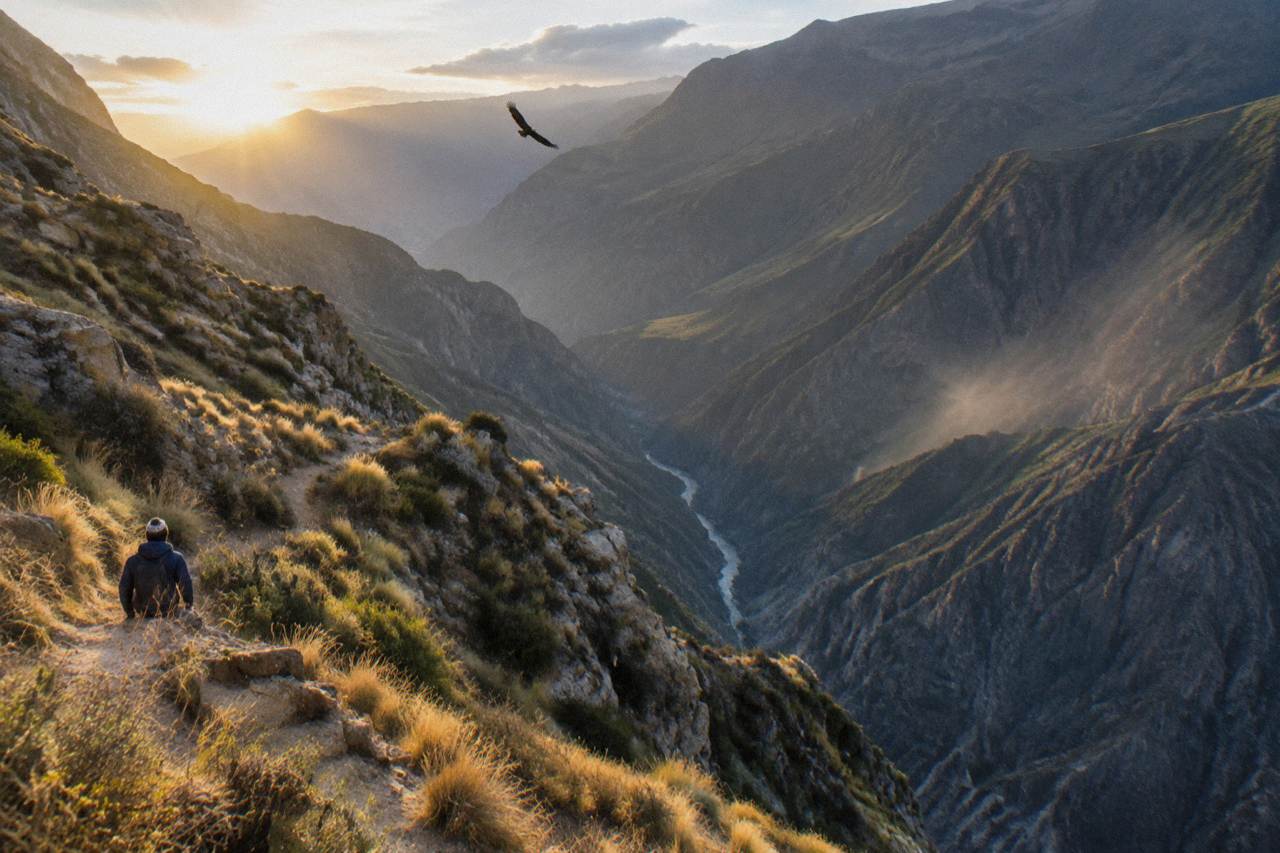
Cruz del Condor sits at roughly 3,270 m on the rim of Colca Canyon, and for a couple of hours most mornings the Andean condors that give the mirador its name ride the thermals past the viewing point. That single spectacle is the reason most people say yes to Colca. The question worth asking before you commit is narrower: does the canyon earn the one or two days it takes out of a Peru itinerary, given where it sits between Arequipa and Puno?
Is Colca Canyon Worth It
Yes, for most travelers combining Arequipa with Lake Titicaca or Cusco. Colca Canyon puts you at a condor viewpoint near 3,270 m, watching Andean condors ride morning thermals, and the canyon-base town of Chivay sits at 3,635 m on a natural route toward Puno at 3,827 m. It typically costs one or two days, so whether that trade suits your schedule is the real question.
The case for Colca is mostly a case about geography. The canyon lies inland from Arequipa, roughly 160 to 190 km and 3 to 4 hours of driving from the city, and the road onward from the canyon-base town of Chivay to Puno takes about 6.5 hours on a scenic bus. In other words, if you are already traveling between Arequipa and Lake Titicaca, Colca is not a detour so much as a different way of doing a leg you were going to drive anyway. Travelers who treat that leg as dead time tend to regret skipping the canyon; travelers who need to reach Puno fast tend to regret stopping.
The case against is equally simple. The classic visit means at least one night at altitude in Chivay, an early start for the morning condor window, and a second day of driving to Puno. If your Peru itinerary is tight around Machu Picchu, or if you are flying from Arequipa onward rather than busing, those days may be better spent elsewhere. The canyon also demands respect for altitude: Chivay at 3,635 m is more than a kilometre higher than Arequipa, and the approach roads cross passes of roughly 4,800 to 4,910 m.
For a full planning treatment of the canyon itself, the complete Colca Canyon planning guide covers tours, timing and where to stay. For the leg that follows it, the Arequipa to Puno bus options page compares the direct and scenic services in detail.

If you are weighing Colca against other booked experiences on the southern route, these three options cover the canyon-to-Titicaca leg in three different styles and price brackets.
What Do You Actually See At Colca Canyon?
The core sight is the Cruz del Condor viewpoint, a mirador at roughly 3,270 m where Andean condors ride morning thermals along the canyon wall. Around it sit the canyon-base town of Chivay at 3,635 m, high passes of 4,800 to 4,910 m on the approach roads, and a valley you view rather than hike unless you book a trek. Most visitors spend a morning at the mirador and move on.
The condors are the headline, and they are wild birds, which is the point. They are not summoned or fed; they appear because the canyon's morning thermals give them lift with almost no effort, and the mirador happens to sit where those thermals run close to the wall. On a clear morning the show can last a couple of hours, with birds passing at eye level and below. On a foggy or wet morning you may see very little, which is why timing matters more than anything else you can control.
The second layer is the landscape itself. The road from Arequipa climbs through high altiplano before dropping toward the canyon, and the driving is genuinely scenic rather than a commute. Chivay, the standard base at 3,635 m, is a small working town with accommodation aimed at canyon visitors, and most two-day itineraries overnight there so the morning mirador window is reachable before the thermals fade.
What you should not expect is a hiking-first experience unless you book one. The standard visit is drive-up viewing: you reach a mirador, watch, photograph and continue. Deeper canyon treks exist as separate multi-day products, but the typical Arequipa-anchored itinerary treats the rim as the destination. Travelers hoping for hours of walking should plan and book for that specifically rather than assuming the day tour includes it.
Ready to lock in the canyon-to-lake leg? The scenic bus from Chivay to Puno can be reserved with free cancellation if your plans are still moving.
When Is The Best Time To See Condors At Cruz Del Condor?
Condors show best in the dry season, April through November, when skies are clearest, and in the morning window of roughly 7 to 10 am, when thermals lift the birds past the mirador. Cruz del Condor sits near 3,270 m, and sightings are possible year-round but weather-dependent. If your trip falls in the wet season, go early, dress warm, and treat a sighting as likely rather than guaranteed.
The season logic is straightforward. The dry months from April to November bring the clearest skies over the canyon, and clear air over sun-warmed walls is exactly what generates the strong morning thermals condors use. The wet season does not empty the canyon of birds; it just adds clouds, rain and the risk that the mirador sits inside fog at the exact hour the birds would have passed. Year-round viewing is possible, but weather-dependent, as local canyon operators note about the Cruz del Condor mirador.
The time-of-day logic matters just as much. The roughly 7 to 10 am stretch is when the sun has warmed the wall enough to set the air moving, and condors that have roosted overnight come out to ride it. Arrive much later and the big display is usually over; the birds have drifted high or away, and the mirador becomes a viewpoint with a queue of coaches. Almost every well-run itinerary is built backward from that window, which is why the classic Colca visit starts before dawn from Chivay.

One weather note worth keeping in mind for any high-altitude leg: alerts for snow and wind above 4,000 m do get issued for the Puno altiplano, so high passes can turn cold and slow in any month, not only in the wet season. Pack a warm layer for the mirador even when the forecast in Arequipa looks mild.
How Do You Fit Colca Canyon Into An Arequipa To Puno Route?
The standard fit is Arequipa to Chivay, roughly 160 to 190 km and 3 to 4 hours of driving, a night or two at 3,635 m, then onward to Puno in about 6.5 hours on a scenic bus. Arequipa at 2,335 m works as the acclimatization stop before the canyon; Puno at 3,827 m is the next altitude step. Doing Colca this way turns a transport day into the highlight between two cities.
The altitude sequence is the part first-time visitors most often get wrong. Arequipa at 2,335 m is the natural place to acclimatize for a day or two before climbing to the canyon. From there the route rises steeply: the passes between Arequipa and Chivay reach roughly 4,800 to 4,910 m, the highest point most Peru itineraries touch by road, before settling at Chivay's 3,635 m. Puno, the next stop, sits at 3,827 m, and Puno's elevation of 3,827 m makes the canyon a sensible stepping stone rather than an altitude spike. Standard guidance for the region is gradual ascent, rest on arrival, hydration, light meals and skipping alcohol at height.
The onward leg is where the canyon pays for itself. Rather than returning to Arequipa and busing to Puno the long way, most canyon itineraries continue east from Chivay across the altiplano to Puno in about 6.5 hours, with stops at viewpoints along the way. The scenic bus from Chivay to Puno is the bookable version of that leg, from $41.03 with free cancellation, rated 4.7 from 88 reviews. It is the piece that turns Colca from a side trip into a route.
Hop-on hop-off travelers should know the boundary here. Peru Hop's Arequipa to Puno service runs that corridor daily with scenic stops, hotel or hostel pickup and drop-off in participating locations, and a bilingual local host on every bus. It does not detour into the canyon itself; via-Colca itineraries are typically sold as separate two-day tours, so canyon visitors either book that side tour or ride the corridor services between the cities.
| Stop on the route | Elevation | Why it matters |
|---|---|---|
| Arequipa | 2,335 m | Acclimatization stop before the climb |
| Cruz del Condor mirador | ~3,270 m | The condor viewpoint, lower than Chivay |
| Chivay | 3,635 m | Canyon-base town for overnight stays |
| Puno | 3,827 m | Next altitude step toward Lake Titicaca |

How Do The Transport Options On The Colca To Puno Leg Compare?
Three booked options cover the Colca and Puno legs: the Turist Bus Colca Canyon from Chivay to Puno from $41.03, about 6.5 hours, rated 4.7 from 88 reviews; the Cusco Route of the Sun scenic bus to Puno from $50, about 11 hours, 4.7 from 633 reviews; and the PeruRail Titicaca Train from $395, about 10 hours, with 294 reviews and no star rating shown on its listing. Each fits a different budget and style.
| Option | From | Duration | Rating and reviews |
|---|---|---|---|
| Turist Bus Colca Canyon, Chivay to Puno | $41.03 | ~6.5 hours | 4.7 from 88 reviews |
| Route of the Sun, Cusco to Puno | $50 | ~11 hours, 6:10 am to 5:30 pm | 4.7 from 633 reviews |
| PeruRail Titicaca Train, Cusco to Puno | $395 | ~10 hours | 294 reviews, no star rating shown |
The Chivay-to-Puno bus is the canyon traveler's option and the value pick of the three. At from $41.03 for roughly 6.5 hours with scenic stops, it converts the least interesting part of the day, the empty altiplano crossing, into a sightseeing run, and it is the natural continuation of any Colca overnight. The 4.7 rating from 88 reviews is a modest but solid pool for a route service, and free cancellation gives some flexibility if your canyon plans shift.
Travelers coming from the Cusco side of the lake have a different decision. The Route of the Sun scenic bus runs Cusco to Puno in about 11 hours, departing around 6:10 am and arriving around 5:30 pm, with cultural stops and a buffet lunch included, from $50. It is rated 4.7 from 633 reviews, a much larger pool, and it pairs naturally with a Colca visit if your route runs Cusco to Puno to the canyon rather than the reverse. The long day is the trade: it is a full daylight commitment.
At the other end of the budget spectrum sits the train. The PeruRail Titicaca Train covers Cusco to Puno or the reverse in about 10 hours, from $395, with 294 reviews on its listing and no star rating displayed (see Lima Cusco Train?). It is a sightseeing train rather than transport, aimed at travelers who want the altiplano crossing to be the event of the day, and the price reflects that positioning. For most canyon visitors the bus legs do the same job at a fraction of the cost.
Is Colca Canyon Worth It If You Are Short On Time?
Colca is worth it with at least two spare days between Arequipa and Puno, and a stretch with only one. The classic visit pairs a night in Chivay with the morning mirador window; a rushed day trip from Arequipa means 6 to 8 hours of round-trip driving for that same window. Skip Colca if your schedule only allows a direct Arequipa to Puno bus, and spend the saved days at Machu Picchu or on Lake Titicaca.
Run the arithmetic honestly. A day trip from Arequipa means 3 to 4 hours each way, so 6 to 8 hours in a vehicle for a morning at the mirador, most of it at significant altitude. It is doable and many people do it, but it is a long day that buys you the condor window and little else. The overnight version costs you a second day and buys the sunset and sunrise over the canyon, a calmer morning at the viewpoint before the coach crowds, and a scenic onward leg to Puno instead of backtracking to Arequipa.
Travelers moving fast down the corridor have a legitimate skip case. Direct services between Arequipa and Puno cover the roughly 300 km in the 6 to 7 hour range, and if Machu Picchu or the Uros islands are the priorities, those days are better spent there. For hop-on hop-off travelers weighing flexibility, Peru Hop passes are valid up to one year from first use with date changes in the app up to 12 hours before departure, which suits shifting plans on a fast route. The honest trade-off: a pass costs more than a bare Cruz del Sur or Oltursa seat once taxis and tours are totted up, and it is not the cheapest option for a traveler who just wants one direct seat.
| Your situation | Verdict | Why |
|---|---|---|
| Two or more days between Arequipa and Puno | Go | The canyon turns a transport leg into the trip's highlight |
| One day only, based in Arequipa | Split decision | 6 to 8 hours of driving buys the morning condor window and little else |
| Heading straight to Puno or Cusco | Skip | Direct corridor services are faster; save the days for Machu Picchu or Titicaca |
That verdict ladder is the honest summary. The site's route planners, including the leg-by-leg breakdowns on Lima To Cusco, exist precisely because the answer changes with your calendar. Colca rewards travelers with slack in the schedule and punishes nobody who skips it, provided the days go somewhere better.
If Colca is in, these are the three booked experiences that carry the canyon and lake legs.
Common Questions About Colca Canyon
Is Colca Canyon Worth It?
For most travelers routing between Arequipa and Lake Titicaca, yes. The canyon delivers wild Andean condors at a drive-up mirador near 3,270 m, sits on a natural route toward Puno at 3,827 m, and costs one or two days. Travelers with tight schedules around Machu Picchu can skip it without missing the core of a first Peru trip.
What elevation is Chivay?
Chivay, the canyon-base town where most visitors overnight, sits at 3,635 m. The passes on the approach road from Arequipa reach roughly 4,800 to 4,910 m, and Arequipa itself, at 2,335 m, is the recommended acclimatization stop before the climb.
When can you see condors at Colca Canyon?
The best window is the dry season, April through November, during the morning hours of roughly 7 to 10 am, when thermals lift the birds past the Cruz del Condor mirador. Sightings are possible year-round but weather-dependent, and wet-season mornings carry a real fog risk.
How long is the bus from Chivay to Puno?
The scenic bus from Chivay to Puno takes about 6.5 hours, from $41.03, with viewpoint stops along the altiplano. It is rated 4.7 from 88 reviews and can be booked with free cancellation.
How far is Arequipa from Chivay?
Roughly 160 to 190 km, typically 3 to 4 hours of driving depending on the service and stops. The route climbs through passes of about 4,800 to 4,910 m before dropping to Chivay at 3,635 m.
Does Peru Hop go to Colca Canyon?
No. Peru Hop runs the Arequipa to Puno corridor with scenic stops, hotel pickup and drop-off and a bilingual host on every bus, but it does not detour into the canyon itself. Visiting Colca typically means a separate side tour or a two-day itinerary, then rejoining the corridor toward Puno.