Is Huacachina Worth A Stop On The Way To Cusco
A route-stop decision guide to Huacachina: how long to give the desert oasis, how to get in and out by bus, leg times to Paracas, Nazca and Arequipa, and what you trade off by stopping.
Is Huacachina Worth A Stop On The Way To Cusco
Yes, for almost every traveller. Huacachina sits 75 km and roughly an hour from Paracas, low at around 368 to 404 metres, so it breaks up the long climb toward Cusco without adding altitude stress. One night is the sweet spot: a sunset dune ride, a morning walk, then an afternoon bus toward Nazca or Arequipa.
The question is not really whether Huacachina is a remarkable place in itself. It is a small oasis village on the edge of Ica, a five minute taxi from a working city of half a million people, and the lagoon at its centre is modest. The question is whether it earns a slot in a route that already asks a lot of your days: Lima to Cusco overland means 20 hours or more of driving even without detours, and every stop you add either extends the trip or forces you to cut something else.
The case for stopping comes down to geometry and contrast. The southern route climbs steadily from sea level at Lima through Paracas at 2 to 3 metres, then Huacachina at roughly 368 to 404 metres, then Nazca at about 520 metres, before the road turns inland and climbs hard toward Arequipa at 2,335 metres and eventually the altiplano above 3,800. Huacachina is the last genuinely flat, warm, low-altitude stop before that climb begins. If you are pacing yourself against altitude, and you should be, the coast is where you want your easy nights.
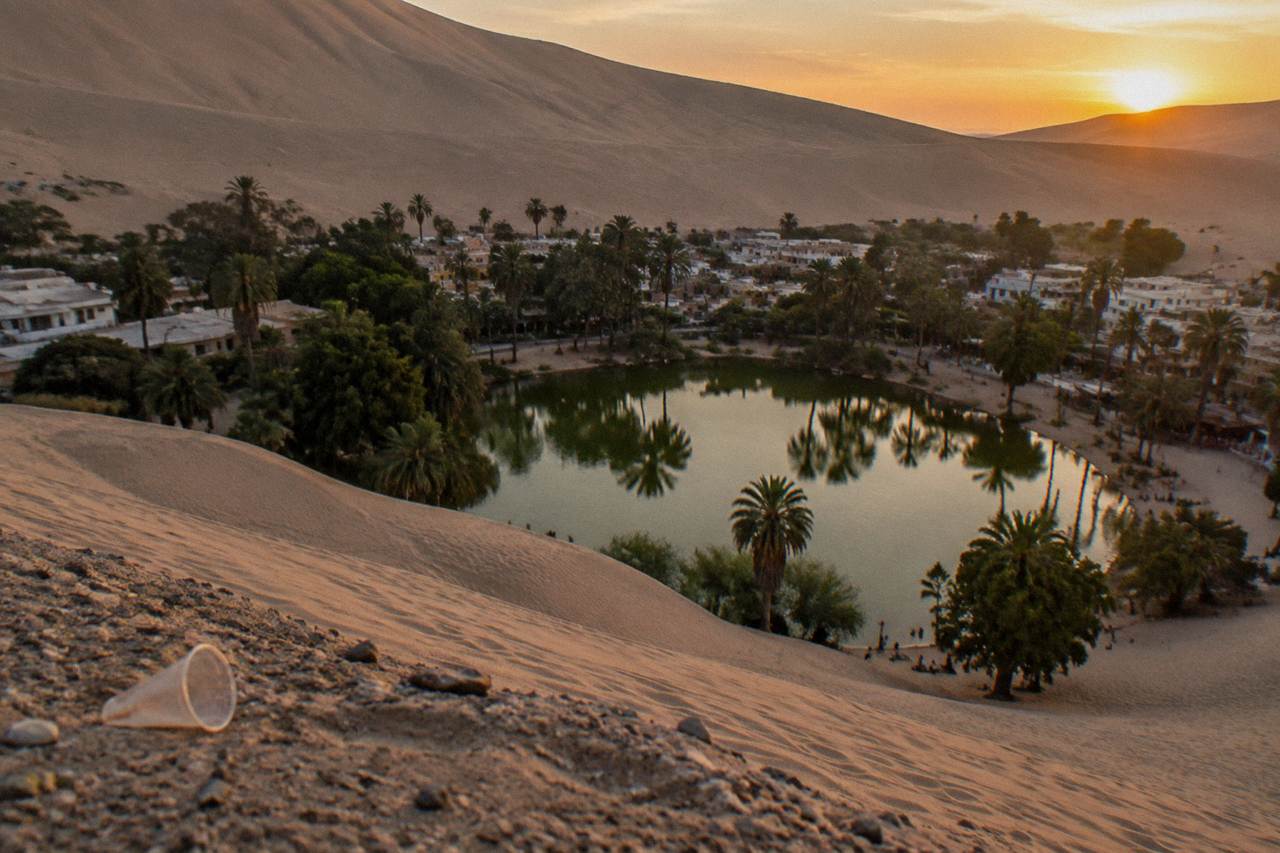
There is also the simple fact that the dunes are genuinely dramatic. The sand ridge that rises directly behind the village runs for kilometres, and the standard way to experience it, a dune buggy ride with sandboarding stops, is loud, fast and unlike anything else on the Lima to Cusco corridor. Some travellers find it touristy, and it is. Others remember it as the most fun three hours of a three week trip. Very few forget it entirely.
The case against stopping is time. If your total budget is ten days or fewer and Machu Picchu is the priority, a full night in Huacachina may be the thing you cut, and there is a respectable argument for doing the oasis as a day trip from Lima instead and flying to Cusco the next morning. That trade-off, night versus day versus skip, is what the rest of this article works through, along with the practical mechanics of getting in, out and onward.
For travellers who do want the stop handled for them, the two most common ways to book it look like this:
Both of those day trips bundle the oasis with Paracas, which is the other great coastal stop, and both finish with you back in Lima late at night. The alternative is to travel independently, which is what the next section covers, because the buses involved are cheap, frequent and easy to book once you understand how the legs fit together.
How Do You Get To Huacachina From Lima?
There is no direct bus to the oasis itself. You take a Lima to Ica or Lima to Paracas service, then a short taxi or colectivo from Ica city to Huacachina, about 4 km and 10 to 15 minutes. The Lima to Paracas leg runs 260 to 272 km and takes 3.5 to 4.5 hours; from Paracas to Huacachina it is 75 km and 1 to 1.5 hours.
The key thing to understand is that Huacachina is not a bus destination. Long distance buses run the Panamericana Sur between Lima, Ica, Paracas and Nazca, and none of them enter the oasis lane. Ica city is the transport hub. Cruz del Sur, Oltursa and Civa all serve it from Lima, with the southern services departing mainly from the Javier Prado terminal area in La Victoria rather than Plaza Norte. From the Ica terminal or from a company office in the centre, a taxi to Huacachina is a short, cheap ride, and colectivos run the route too for less.
The other approach is a hop-on hop-off pass. Peru Hop picks up and drops off at your hotel or hostel in participating locations, so you skip the bus terminal with your bags, and Huacachina is one of its standard stops on the southern route: the pass covers the Lima to Paracas leg, then Paracas to Huacachina, with the bus arriving in the Huacachina area the same day. A bilingual English and Spanish host rides every Peru Hop bus, which matters if your Spanish is thin and you are working out connections on the fly. The trade-off is cost: a hop-on hop-off pass costs more than a bare Cruz del Sur or Oltursa seat before you tally in the taxis and tours it replaces, so it is not the cheapest option for a traveller who just wants one direct seat.
If you would rather compare the plain bus tickets yourself, the guide to the Lima to Huacachina bus route breaks down the operators, terminals and timings leg by leg, and the Lima to Paracas bus guide covers the first stretch in detail. For a sense of how the pieces chain together, a typical independent day looks like an early departure from Lima around 6 or 7 a.m., arrival in Paracas or Ica before noon, and either a same afternoon transfer to the oasis or a night in Paracas first.
Peru Hop's own published itineraries illustrate the timing: departures from the Huacachina area around 2 p.m. reach the Nazca viewing tower around 4:30 p.m., which tells you the Ica to Nazca leg, 119 to 143 km depending on the exact start point, runs about two to three hours. That is the rhythm of the whole coast: short legs, frequent departures, easy to resequence.
One safety note worth having in mind before you commit to overnight schedules. Both the US State Department and the UK FCDO advise the same thing about Peruvian roads: "Bus crashes are common, especially at night. Only use reputable transport companies, and where possible, avoid overnight travel, especially in mountainous and remote regions." The current Peru travel advisory permits its own staff to ride commercial buses at night on the Lima, Arequipa, Cusco corridor specifically, which is a reasonable signal that the main southern routes are the well-managed end of the network. On the coast, daytime legs between Lima, Paracas, Huacachina and Nazca are short enough that you rarely need a night bus at all.
If reading all of that makes you want someone else to handle the connections, the premium day trip is the shortcut:
One Night Or A Day Stop: How Long Should You Give Huacachina?
One night, in almost every case. A day stop gives you four to six hours, enough for a buggy ride and lunch but not the sunset or the quiet morning. Two nights is usually too many: the village is small, the activities are evening-weighted, and every extra night here is a night not spent in Arequipa, Colca or Cusco.
The structure of the place decides this. Huacachina's two great moments are the late afternoon, when the dunes turn from beige to orange and the buggy tours run, and the early morning, when the sand is cool, the tour groups have not arrived and the ridge walk is silent. A day stop captures neither well. Arrive at midday, as most passing tours do, and you get the hottest, flattest light of the day and the village at its most crowded.
A one night stay sequences naturally. Arrive in the afternoon from Lima or Paracas, check in, and take a buggy tour in the late afternoon slot, which ends around sunset on the dune crest. Eat, sleep, and give the morning to the ridge walk or simply to coffee by the lagoon before an afternoon bus onward to Nazca or, with a connection, Arequipa. You lose nothing from the rest of your route and you gain the two hours the day-trippers miss.
The overnight question also interacts with altitude in a way that is easy to miss. Huacachina sits at roughly 368 to 404 metres, essentially sea level, and Nazca at about 520 metres is barely higher. Arequipa, by contrast, is 2,335 metres, and Puno above 3,800. A night in Huacachina is a night of full oxygen, deep sleep and no acclimatization burden, which is exactly what you want immediately before the climb. Travellers who rush from the coast to Cusco at 3,399 metres in one push tend to feel it.
| Stop style | Time on the ground | What you get | What you miss | Best for |
|---|---|---|---|---|
| Drive-through, 2-3 hours | Lunch and a photo | The lagoon, the viewpoint | Dunes at any good light, the buggy ride | Tight schedules already committed elsewhere |
| Day stop, 4-6 hours | Afternoon only | Buggy ride, sandboarding, lunch | Sunset from the dune crest, the quiet morning | Travellers bound onward the same evening |
| One night | Roughly 20 hours | Sunset ride, dinner, morning ridge walk | Nothing significant | Almost everyone |
| Two nights | 44+ hours | All of the above, slowly | A night in Arequipa or Paracas | Dune enthusiasts, slow travellers |
The one honest argument for the day stop is that the premium day trips do it well. The "Premium Day Trip, Sunset Toast" from Lima runs about 16 hours, hits the Ballestas Islands at Paracas in the morning, reaches the dunes for the late afternoon and includes a toast as the sun drops, and it carries a 4.8 rating from 2,636 reviews with free cancellation. If your itinerary has no room for an overnight anywhere on the coast, that product, or the Paracas and Huacachina premium day trip as we cover it on the tour page, is a legitimate substitute for a night in the oasis. Check availability if that shape fits your dates.
What Does A Stop At Huacachina Actually Involve?
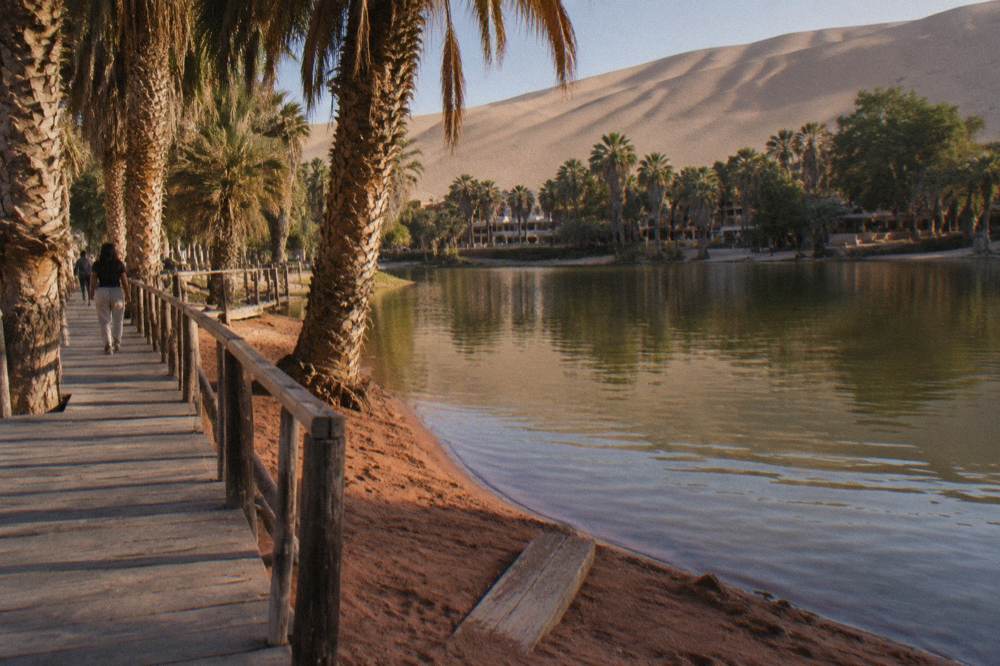
Two things, mostly: the dune buggy ride with sandboarding, which takes two to three hours and runs in the late afternoon, and the walk or drive up the big dune behind the village for sunset. Around those sit the lagoon, a small strip of restaurants and bars, and a short boardwalk. That is the entire attraction, and it is enough for one evening.
The buggy ride is the reason most people stop. Operators run purpose-built dune buggies, essentially roll cages with V8 engines, up and over the ridge system west of the village, stopping on steep faces for sandboarding. It is closer to a fairground ride than a nature tour, and reviews divide exactly along that line: some travellers describe it as the highlight of their Peru trip, others as an expensive rollercoaster in a desert. The sunset departure is the one to book if you book any, because the light on the dunes does most of the work. The rest of the planning pages sit on Lima To Cusco.
The sandboarding itself is optional on every run. Most drivers carry boards and offer them at each stop, and the learning curve is a single slide: sit on the board if standing fails. Wear closed shoes, the sand gets everywhere regardless, and take nothing on the buggy you would mourn losing.
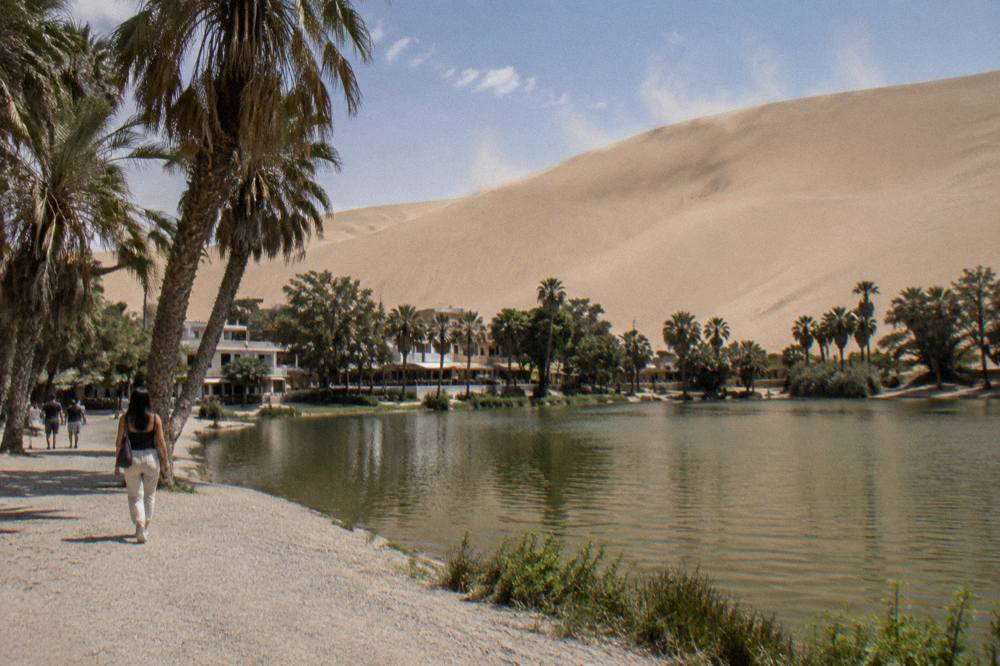
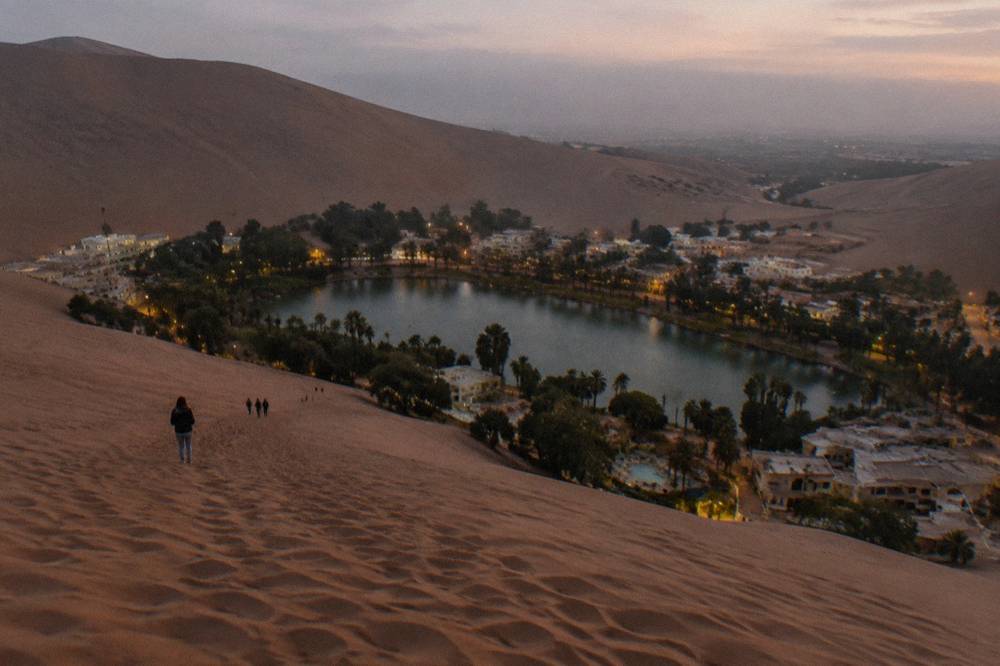
The village walk takes twenty minutes. The lagoon is small, ringed by palm trees and a handful of buildings, and in recent years its water level has visibly dropped, a fact locals discuss openly; the oasis is a fragile feature, not a lake. The viewpoint partway up the dune behind the village gives the postcard shot, and the full ridge walk to the crest takes 30 to 45 minutes on loose sand, harder than it looks and best done before the heat.
For travellers who would rather not arrange the oasis themselves, the "Premium Day Trip, Peru Hop Run" version of the coastal day trip is the other major bookable option: from $67, 16 to 18 hours door to door, and carrying a 4.9 rating from 9,650 reviews, one of the largest review pools on this site's whole roster. It pairs Paracas in the morning with the dunes in the late afternoon and finishes with the sunset toast before the drive back to Lima.
Whether that or the independent overnight suits you better depends on one variable: where you sleep that night. The day trips return you to Lima, which is the wrong direction if Cusco is next. The overnight keeps you moving south.
What Do You Skip By Stopping At Huacachina?
Realistically, you skip nothing that competes on the same night, because the coast's stops are cheap in time. The real costs are the extra day the overnight adds to the itinerary and the Lima night you give up. What you never have to skip is Paracas or Nazca: both chain naturally before or after the oasis, on buses that run daily.
It helps to see the southern route as a sequence of short hops rather than one long haul. Lima to Paracas, 3.5 to 4.5 hours. Paracas to Huacachina, an hour or so. Huacachina to Nazca, two to three hours. Nazca to Arequipa, the long one, roughly 405 km and 9 to 10 plus hours on the direct public buses. The oasis slots into this chain without forcing any detour; the road passes within 4 km of it. The only thing a Huacachina night truly costs is a calendar day, and a night in Lima or a night in Ica city, neither of which most itineraries mourn.
The sharper trade-offs sit elsewhere. If your trip is short, the day you spend on the dunes is a day not spent in Arequipa's Santa Catalina convent, on the Colca Canyon rim at Cruz del Condor, or acclimatizing in Cusco before a Machu Picchu day. Those are the competing uses of the same 24 hours, and for a ten day trip that already includes Paracas, the honest answer is that Huacachina is the most cuttable of the coastal stops, precisely because a day trip version exists that costs no nights at all.
What you do not have to choose between is Huacachina and Paracas. They are 75 km apart and every southbound service links them. The Paracas to Huacachina bus guide covers that hop in detail, including how the Ballestas Islands morning boats and the dune afternoon fit into a single day if you are determined to compress.
And what does a pass-through cost you? If you skip the oasis entirely, riding Lima to Nazca or Lima to Arequipa direct, you trade a desert sunset and a fun three hours for a saved day. Some travellers, especially those who have seen dunes elsewhere, make exactly that call and regret nothing. But for a first trip to Peru, the oasis is the coast's most concentrated dose of the unusual, and the price of admission is one night and one short taxi.
Getting Out: Onward Buses From Huacachina Toward Cusco
Leave the same way you came in: a 10 to 15 minute taxi or colectivo from the oasis to Ica city, then a southbound bus. Ica to Nazca takes two to three hours; Nazca to Arequipa is the long leg at roughly 405 km and 9 to 10 plus hours; from Arequipa the route climbs to Puno and on to Cusco.
The onward mechanics are the mirror of the arrival. No long distance bus collects at the oasis itself, so the morning ritual is a short taxi to Ica and a ticket on the next Cruz del Sur, Oltursa or Civa departure south. Buy the Ica to Nazca or Ica to Arequipa ticket the evening before if you can, since the comfortable daytime departures fill first, and remember the baggage norms: Cruz del Sur allows up to 20 kg tagged in the hold with a 6 kg carry-on, and Oltursa runs similar limits.
For the hop-on hop-off crowd, the pass covers the onward legs too. Peru Hop runs the Huacachina to Nazca stretch with its published itinerary showing the 2 p.m. departure reaching the Nazca viewing tower around 4:30 p.m., and the service continues to Arequipa, Puno and Cusco, the end of the line. Machu Picchu is not on any bus route from anywhere: from Cusco it is train or trek, which is a separate decision covered in our Cusco to Machu Picchu train material. Passes are valid up to one year from first use, with date changes in the app up to 12 hours before departure, which suits a route like this where plans slide by a day.
If you are heading north instead, back toward Lima for a flight, the pieces run in reverse: Ica or Paracas to Lima is an afternoon on the Panamericana, and the "Direct Bus, One Way" Lima to Paracas service, from $19 with a 4.2 rating from 53 reviews, is the cheap spine of that stretch, with free cancellation. Some travellers use it as the first leg of a self-assembled coast trip, pairing it with local taxis and their own hotel bookings.
The altitude picture changes fast after Nazca. The road climbs from about 520 metres at Nazca to 2,335 metres at Arequipa, and the passes beyond Arequipa toward Puno reach above 4,800 metres on the Colca detour. Pack layers for the bus: the altiplano and the 4,000 metre plus passes are cold at night even when the coast was 30 degrees, and while premium services run climate control and blankets on semi-cama and cama classes, a fleece in your daypack costs nothing. Our coastal transport guide and the Lima to Paracas route data both track the current timetables if you are stringing the legs together yourself.
One general caution, stated generally because specifics change: roads in Peru occasionally see strikes or protests, and blockades can close stretches of highway with little notice. Check conditions the day before each long leg, keep your schedule loose by half a day where you can, and book the buses whose operators have a clear rebooking policy.
By the time you board the Nazca or Arequipa bus, the decision is already made and, for most travellers, already vindicated: one flat, warm, oxygen-rich night, a sunset on the biggest dunes on the route, and a story that costs a single day of a trip that was always going to be too short anyway. If you are still assembling the coastal legs, these are the three bookings that cover the Huacachina question from every angle:
Common Questions About Huacachina
Is Huacachina Worth A Stop On The Way To Cusco?
Yes, for most travellers. It is the last low, warm stop before the route climbs to Arequipa and the altiplano, the dune buggy and sandboarding afternoon is unlike anything else on the corridor, and one night costs almost nothing in routing since the road passes within 4 km. Skip it only if your trip is too short to spare a day and a Machu Picchu priority is squeezing the coast.
How many hours do you need at Huacachina?
Four to six hours covers the buggy ride and the lagoon, but the good light is late afternoon and early morning, which is why one night beats a day stop. Arrive mid afternoon, ride the dunes at sunset, and leave the next afternoon.
Do buses go directly to Huacachina?
No. Long distance buses serve Ica city, about 4 km away, and Paracas, 75 km away. From Ica it is a 10 to 15 minute taxi or colectivo to the oasis. Hop-on hop-off passes stop at the Huacachina area directly and pick up at accommodations in participating locations.
What is the best way to do Huacachina from Lima?
Either an independent overnight: a bus to Ica or Paracas, a taxi in, a night at the oasis, then an onward bus. Or a premium day trip from Lima, which pairs the Ballestas Islands at Paracas with the dunes and a sunset toast in one 16 to 18 hour day and returns you to the capital that night.
Is Huacachina at altitude?
Barely. The oasis sits at roughly 368 to 404 metres, effectively sea level, and Nazca at about 520 metres is the next stop. The altitude only begins in earnest at Arequipa, 2,335 metres, so a Huacachina night costs you nothing acclimatization-wise and gives you a full-oxygen sleep before the climb.
Can you get from Huacachina to Machu Picchu?
Not directly, and no bus reaches Machu Picchu from anywhere. The route is Huacachina to Ica, buses onward to Arequipa, Puno and Cusco, then a train or trek from the Cusco area to Machu Picchu, with the standard connection through Ollantaytambo station.